Manos Papazoglou
Cartes Postales from GreeceManos Papazoglou’s attempt to inherit his father’s hotel empire turns a contest between two pampered brothers into a study of ambition cornered by coercion: the port-side Hotel Pyrgos he means to make his fortress becomes the scene of his financial ruin and a fatal assault.
Identity and Background
Manos is the elder son of Apostolos Papazoglou, whose expanding luxury-hotel business has made the brothers heirs to a substantial empire. By their twenties, Manos and his younger brother, Stephanos Papazoglou, have spent a decade of summers in their father’s resorts, living on room service and Coca-Cola. Neither has ever made a bed. Their earlier family life in a one-bedroom apartment in Patras survives only as a contrast to their present privilege: they have no memory of sharing a divan head to toe with their parents.
The Succession Contest
Their entitlement had been cultivated at home as well as at the resorts. Their mother praised them even when they did badly at school, while Apostolos Papazoglou was too absorbed in making money to pay them much attention. As his seventy-fifth birthday approached, he wanted to retire without dividing his hotel group, but refused to hand it automatically to Manos simply because he was older. In private, he considered Stephanos more charming and better suited to lead the business.
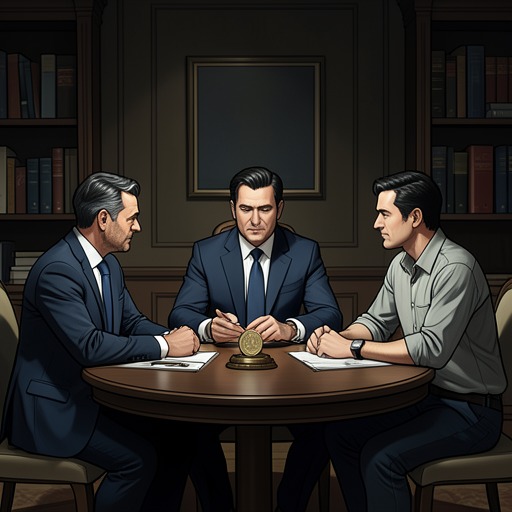
On 13 October, at a family celebration in a smart Patras restaurant, Apostolos interrupted his sons’ argument about football to announce a contest. He had two undeveloped sites: one near the busy port, the other on a stretch of beach outside town. An old drachma from his desk would assign the plots, and after two years the son with the stronger balance sheet—even by just ten drachmas—would inherit the empire. The timing made the wager feel ominous. Waiters muttered that the thirteenth was unlucky, especially in Greece, where the digits of 1453 also add up to thirteen; the maître d’ regarded the coin toss as pure stupidity. The drachma nevertheless settled the matter: Manos received the port-side site, while Stephanos got the beach plot.
Neither brother had continued studying after leaving school at sixteen. Their poor grades would have limited their university prospects, but they also saw little reason to strive when their father was wealthy and a business future already seemed assured. Manos’s seniority was reinforced by family preference: he bore his late grandfather’s name and had consequently been his grandmother’s favourite. He resented Stephanos’s more attractive girlfriends, even as he disparaged their intelligence. Short like his father and struggling with his weight, Manos took pride instead in his discernment as a gourmet and his appreciation of fine wines. Stephanos, by contrast, had inherited their mother’s balanced features and athletic build; football and water polo were his passions, and Manos watched jealously as an admiring woman seemed always to be at his brother’s side.
Hotel Pyrgos: Strategy and Coercion
Manos rejected the seasonal tourist trade as the basis of his business. He wanted income throughout the year, so he aimed Hotel Pyrgos at businesspeople, commercial travellers, and dock workers—customers he believed had money to spend—and promised them a degree of sophistication unusual in Patras. His site already contained a vast, empty office block, a box-like structure with holes for windows. Demolishing it would be costly, so he chose to convert it. With a ruler, a set square, and a blank sheet of paper, he spent twenty minutes sketching a medieval castle inspired by a childhood visit to the old castle at Nafplio. The square, solid design, with turrets and crenellations, became his personal fortress: Hotel Pyrgos.
The fortress was vulnerable from its opening months. Giorgos Kourtis, who owned a rival hotel in the town centre, had visited the Pyrgos as a customer, gambled in its private room, and spent time there with one of the women. Manos eventually understood that Kourtis’s real concern was the business he was losing to the new hotel. Kourtis also had powerful connections, and Manos kept from his father—and almost from himself—what was happening behind the scenes.
About five months after the opening, the electricity failed. Manos initially made the outage seem romantic by having candles brought in, but the electricians found no fault in the system: the hotel had been cut off. Reconnection would cost five million drachmas. The water was then cut off too, with the same price demanded to restore it. Manos came to recognize the exorbitant charges as extortion. Police searches followed, heavy-handed and destructive, supposedly looking for gambling evidence. They found it, knew exactly where to look, and returned regularly. Manos concluded that only a substantial bribe to the right people could keep the visits from destroying the business; survival meant paying both the extortion and the bribes.
The sums did not save the Pyrgos. Manos’s outgoings soon exceeded his income, and the winter exposed the cost of the hotel’s weaknesses. Power cuts left rooms without heat; when winds came in from the Ionian, indoor temperatures could fall below ten degrees. Condensation dripped down the walls, the painted muses of Botticelli began to flake, and guest numbers fell sharply. As the next summer season approached, the building meant to last like a castle was already deteriorating. Its image of permanence stood against the accumulating evidence of neglect and financial failure.
With only four months remaining before he had to show his father the October balance sheet, Manos took out several loans to meet the continuing demands for money. He knew Kourtis was orchestrating the pressure and feared that refusing to cooperate would cost him both the hotel and his future. Debt kept him awake; stress brought regular asthma attacks. His weight increased until climbing to his second-floor office was difficult, while he could not afford to repair the lift. His girlfriend of six months, a record for him, had first been attracted by his position as owner of the town’s grandest hotel, but left when she saw its price. The contrast with Stephanos’s booming Thalassa sharpened Manos’s predicament: Stephanos could earn profits by opening for only six months, while the Pyrgos’s year-round ambitions were being consumed by coercive payments, cold rooms, and shrinking custom.
Collapse, Violence, and Consequences
The earthquake exposed the difference between the brothers’ hotels in the starkest possible terms. The Thalassa lay in ruins, and thirty of its more than two hundred guests were killed; investigators found that the building had been constructed without regard for guest safety. The Pyrgos suffered only a cracked window. But the damage to Stephanos’s hotel brought lawsuits from bereaved families and roughly a hundred wounded guests, while Manos’s own business was already collapsing for reasons no small repair could reverse. On the day Stephanos was charged, Manos’s debts had become impossible to repay, his last guest departed, and the final staff member left after six months without wages. Manos went to the bar, took the only decent whisky remaining—a bottle of Johnnie Walker—and drank from it as he walked the stone corridor. At the reception door he found Orestes Sakaridis, the local police officer who had repeatedly come to demand the usual payment. On Sakaridis’s wrist was the watch Apostolos Papazoglou had given Manos for his twenty-fifth birthday; during an earlier visit, when Manos had run out of money, he had surrendered it in lieu of cash. Seeing the watch on the officer made plain how thoroughly the demands had stripped him of what he owned. With nothing left to offer, Manos unbolted the door and confronted him. Drunk, Manos lurched at Sakaridis and swung the bottle toward his face. The officer avoided the blow and seized his shoulders, but Manos wrenched free and drove an elbow into his stomach, putting his full weight behind it. Sakaridis fell backward, striking the side of his head on the marble step, and lay still. Two other policemen soon found Manos smelling of alcohol and put him in their car; on the way, they heard over the radio that their colleague’s body had been found on the Pyrgos steps. The hotel whose proprietor had tried to make it a fortress had become the setting for an irreversible act of violence. Apostolos’s seventy-seventh birthday, which was meant to mark his retirement and the transfer of the hotel empire, instead found both sons facing trials in Athens. Seven months later, on 29 May—the date on which the rival hotels had opened—both received manslaughter verdicts. The people of Patras recognized the date as another sign of the ill-omened decision made on the thirteenth: the compensation owed to injured guests and bereaved families exceeded what the entire hotel group could raise through its sale. Apostolos was forced to declare bankruptcy. Manos’s private business failure thus became part of a wider collapse, binding the family’s succession contest, coercion, unsafe construction, and fatal consequences into one ruinous outcome.